The Clock Starts When the Aircraft Lands
A C-130J sits on the apron waiting for fuel system maintenance. The expected standard gravity drain time: 20-plus hours, a lot of time lost before any work can be done to the plane’s fuel systems.
Every minute an aircraft spends in maintenance is a minute it isn’t flying. Defueling is a standard part of routine, but its process determines how quickly crews can access fuel systems, enter tanks, and begin the work that depends on empty or reduced fuel loads. The longer defueling takes, the longer those tasks wait.
What Slow Defueling Costs an Operation
Aircraft availability: One commercial MRO reported 14 hours to drain a wide-body aircraft before switching to vacuum methods, while another documented six hours of manual pumping on a 747, cut down to just two hours. Each of those hours is time during which only limited work can be done while the fuel system is made safe. Across a fleet running scheduled heavy checks, the lost availability compounds into reduced throughput.
Fuel loss: Gravity methods leave recoverable fuel trapped in irregular wing geometry, internal baffles, and structural pockets that weren’t designed for drainage. Even at the Department of Defense level, Defense Logistics Agency facilities were losing fuel to evaporation and environmental contamination before efficient recovery was introduced. Read the case study.
Safety and compliance exposure: Open-air gravity draining creates vapor clouds and exposes crews to hazardous fuel contact. When the U.S. Air Force engaged Spokane Stainless Technologies, gravity drainage at facilities worldwide was creating fuel spills on runways, vapor hazards, and environmental contamination that standard procedures weren’t resolving. In commercial environments, simple spills domino into reporting chains, and cleanup operations, which can result in regulatory scrutiny that consumes time and puts day-to-day operations under a microscope.
Why Gravity Draining Falls Short
When fuel drains passively through sump points, internal baffles and stringers create dead spaces where fuel pools. As fuel level drops, flow rate slows, and the last portion barely moves. On large aircraft with multiple fuel cells, each cell drains at its own rate and the process can’t be meaningfully accelerated.
The Royal Australian Air Force documented a C-130 tank venting for three days before switching methods. That’s an extreme case, but even routine gravity drains on commercial wide-bodies run into the same physics at a smaller scale.
While speed is an issue, so is safety. There’s no guaranteed containment, beyond whatever vessel sits underneath the plane to capture removed fuel. Fuel vapor escapes into the work environment continuously. There’s no filtration during the drain, so contaminated fuel can’t be returned to service without a separate handling step, and there is no way to speed it up.
The US Air Force’s original request to Spokane Stainless Technologies was for a mobile bowser with a funnel to catch draining fuel. That would have treated the symptom. The actual problem required rethinking how fuel gets extracted in the first place.
What Vacuum Defueling Changes
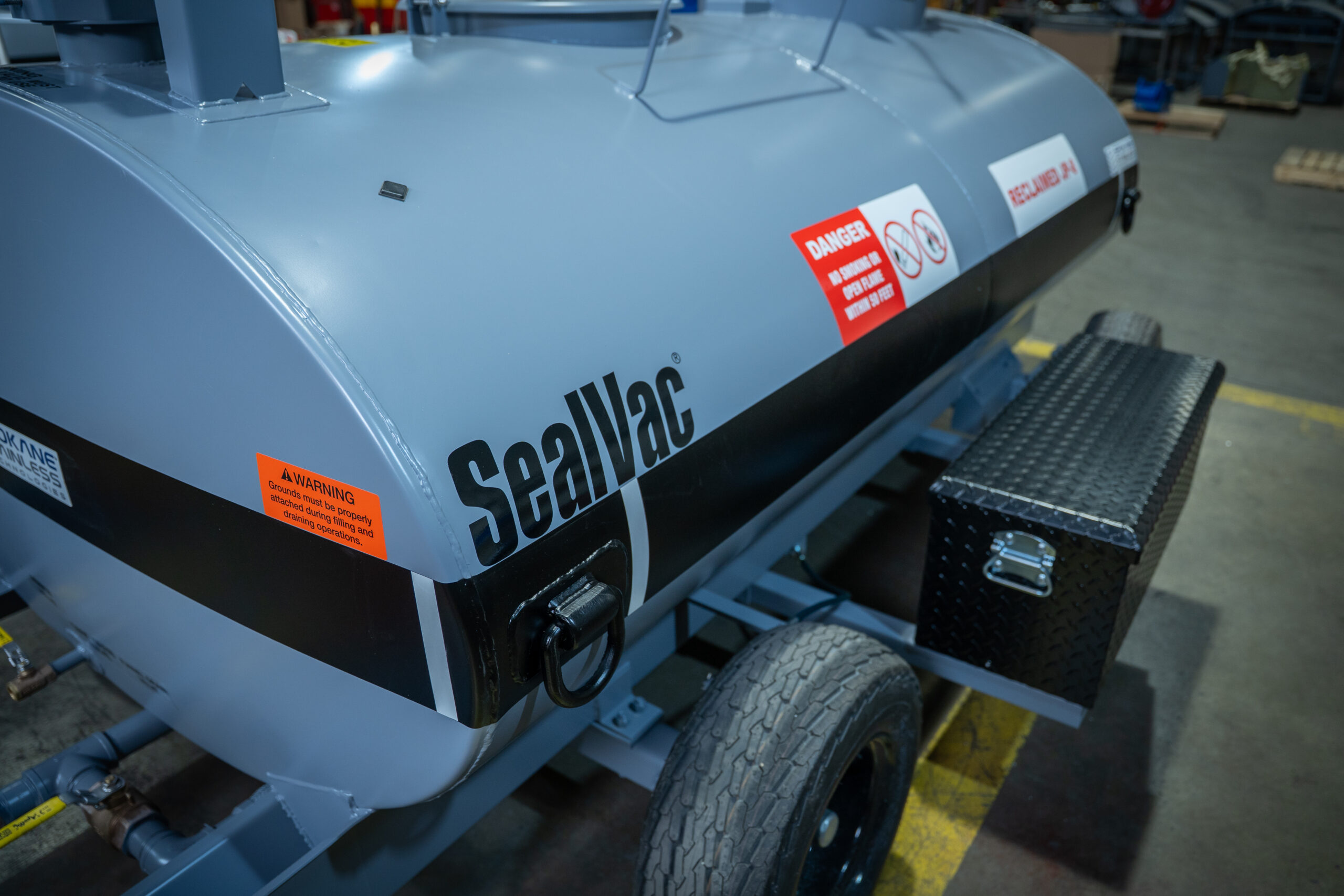
A vacuum system creates sealed connections at sump drain points and actively extracts fuel. The fuel never contacts open air, eliminating spills and vapor exposure at the source. When working with a SealVac or eSealVac, recovered fuel stays in a double-walled containment tank, and with filtration, returns to aviation-grade standards.
Sealed drain tool adherence: Specialized drain tools attach to the aircraft’s sump poppet drain valves using 17 inches of Hg vacuum pressure, creating a hermetic seal against the airframe before fuel transfer begins. The seal holds against curved surfaces, rivets, and panel gaps using interchangeable vacuum area seals sized to the airframe profile.
Passive safety engineering: The system runs on compressed air with no moving parts in the fuel path, eliminating ignition sources. Automatic shutoff triggers at 90% tank capacity, while static bonding exceeds military explosive-atmosphere requirements. The entire fuel path from the aircraft sump to the containment tank is sealed.
What that looks like in practice: One commercial MRO reduced wide-body fuel sumping from 14 hours to two, and another cut 747 drain time from six hours to two. The RAAF reduced C-130 tank venting from three days to two hours. One MRO reported a 4x reduction in drain wait time.
Spokane Stainless Defueling Solutions
The SealVac® is vacuum-powered fuel drain bowser for fixed-wing aircraft. It drains fuel up to 24 times faster than gravity methods using sealed dual-vacuum architecture. Available in 200, 400, and 600-gallon capacities, it runs on existing facility compressed air, has no moving parts in the fuel path, and can be operated by a single person. It’s air-transportable and deployable wherever the aircraft is.
Up to 20 GPM drain rate (tested on USAF B-1 underwing sump). Double-walled tank, vacuum governor, automatic fail-safe shutoff. FAA, DoD, NATO, and ISO compliant. The NSN is available for military procurement.
The SealVac Plus® adds aviation-grade filtration to the recovery process. A pneumatic diaphragm pump transfers fuel at up to 20 GPM while an integrated fuel drying monitor removes particulates and water. A depuddling hose clears residual fuel and FOD after draining. Recovered fuel comes out filtered to aviation-grade standards in the same operation, eliminating the separate defuel-then-filter sequence.
The eSealVac® is the fully electric, self-contained version of the SealVac platform. It runs on four onboard 24VDC batteries with a 200-watt solar recharging panel, so it requires no compressed air and no facility infrastructure to operate. It delivers 25 GPM continuous-duty fuel transfer, 25.1 in Hg of vacuum, and integrated cyclonic pre-filtration that removes FOD and particulate debris before fuel enters the 600-gallon tank. FAA, DoD, and NATO compliant, with an NSN listed for military procurement. Best for remote, forward-deployed, or space-constrained operations where compressed air isn’t available.
Both units are in active service with the U.S. Air Force, U.S. Coast Guard, Boeing, Airbus, Lockheed Martin, Jet Aviation, the Royal Australian Air Force, the Defense Logistics Agency, and major commercial airlines. Our team developed the SealVac in direct collaboration with Air Force maintenance crews through iterative prototyping and field testing.
Learn more about the full fuel products line or how Spokane equipment supports aerospace operations.
Faster Defueling as Competitive Advantage
When an aircraft’s fuel cells are accessible shortly after being removed from service, instead of sitting through long gravity drain, the downstream schedule shifts with it. Inspectors get into tanks sooner, parts sourcing for begins earlier. With SealVac and eSealVac, planes can return to service faster.
The fuel economics compound the same way. Thousands of drain cycles per year, each one recovering fuel that would otherwise be lost or sold at a discount, add up to figures that get harder to ignore over time.
The cost of slow fuel recovery doesn’t show up in one dramatic number. It compounds across every heavy check, at every batch of fuel sold at a loss, and at every hour waiting for the tank to clear. Spokane Stainless Technologies builds defueling systems for operations where those numbers matter.
Contact Spokane Stainless Technologies to discuss defueling requirements for your operation.